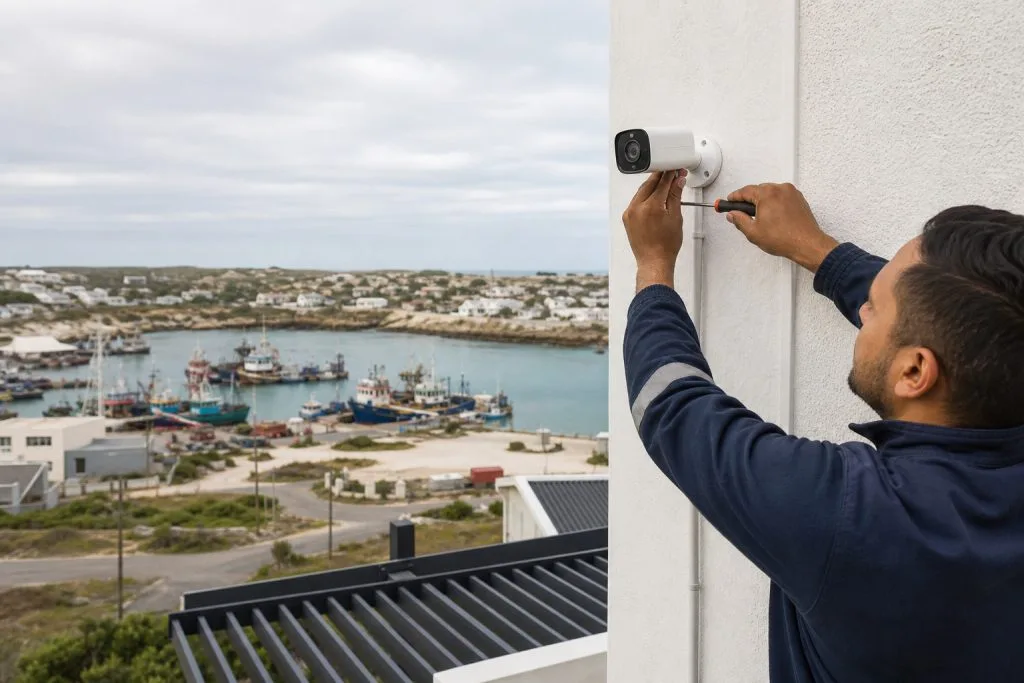
A good CCTV system gives real peace of mind: especially around St Helena Bay, where plenty of homes are holiday houses that sit empty for stretches of the off-season. But the range of cameras and the jargon that comes with them can be overwhelming, so here is a plain-language guide to what actually matters when you are choosing a system.
Start with coverage, not camera count
The instinct is to dot as many cheap cameras around the property as possible. In practice it is far better to cover the key approaches really well than to spread thin coverage everywhere. The places that matter most are the obvious ones: gates, front and back doors, the driveway, and any side access.
A short walk around your property usually makes the priority spots obvious: the routes someone would actually use to approach the house. That walk is exactly how we plan a camera installation: working out the fewest cameras that give you the most useful coverage, rather than selling you a box of eight you do not need.
Night vision and weatherproofing are non-negotiable here
On this coast, two things are essential. The first is proper night vision: most of what a home camera needs to capture happens after dark, and a camera that produces a useless grey smear at night is not protecting you. The second is genuine weatherproofing. Salt air and wind are hard on outdoor electronics, and a camera that is not rated for coastal conditions will fog, corrode or fail within a season or two.
- Cameras with strong infrared or low-light performance for clear night footage.
- Weatherproof housings rated to stand up to salt air, wind and driven rain.
- A recorder (NVR or DVR) with enough storage to keep footage for a sensible number of days.
- Sensible placement out of the worst of the spray where possible, and sealed cabling.
The salt-air challenge is the same one that affects satellite gear, which we cover in our piece on how salt air affects coastal equipment: the lesson is identical for cameras: buy and install for the coast, or replace it far sooner than you should.
Remote viewing is what makes it genuinely useful
The single feature that turns CCTV from a recording you only watch after something has happened into a genuinely useful tool is remote viewing. Set up properly, you can check in on your home from your phone wherever you are: at work, on holiday, or simply from bed when the dog barks.
For holiday-home owners this is the big one. Being able to glance at the gate and the front door from Cape Town or Gauteng, while the house stands empty for months, is genuine peace of mind. We set this up and walk you through using it before we leave, so it actually works when you need it rather than sitting unconfigured.
Cameras need solid internet behind them
One thing people often overlook: remote viewing only works as well as the internet behind it. Cameras at the far corners of a property need a network that actually reaches them, which is why we often pair a camera install with a WiFi and network upgrade: there is more on covering a tricky property in our guide to strong WiFi in a double-storey home. A camera you cannot connect to is not much use when you are away.
How many days of footage do you need?
One spec that quietly decides how useful a system is, is how long it keeps recordings before writing over them. For a permanent home, a week or two is usually plenty: if something happens you will know quickly. For a holiday house that stands empty for a month or more between visits, you want considerably more, so footage from early in your absence is still there when you next check in. The amount of storage needed depends on how many cameras you have, their resolution, and whether they record constantly or only on motion. Motion-triggered recording stretches storage a long way and makes footage far quicker to review. We size the recorder to your actual situation, so you are not caught out by a camera that has already overwritten the moment you needed.
Upgrading or repairing an existing system
Not everyone is starting from scratch. A lot of our camera work is repairing or upgrading setups that have stopped recording, lost their remote view, or simply aged out. Often the cameras are fine and it is the recorder, cabling or configuration that has failed: a much cheaper fix than a full replacement.
CCTV is one of several services our local DStv installers in St Helena Bay can set up alongside your satellite and WiFi system.
n
Whether you want a fresh system or to revive an old one, the principles are the same: cover what matters, choose gear built for the coast, and make sure you can actually see it from your phone. We install and repair CCTV across St Helena Bay, Shelley Point, Britannia Bay and the wider West Coast. Get in touch and we will help you work out the right coverage for your property: no overkill, no jargon.
Keep reading
Which DStv Decoder Should You Choose? A St Helena Bay Guide
.wa{color:#243447}.wa h2{font-size:clamp(24px,3vw,32px);font-weight:800;line-height:1.2;margin:38px 0 14px;color:#0F2741}.wa h3{font-size:clamp(18px,2.2vw,22px);font-weight:700;mar
TroubleshootingDStv Error E16 in St Helena Bay: What It Means and 5 Fixes
DStv error E16 on your screen in St Helena Bay? Here is what the scrambled message means, the…
MaintenanceHow salt air affects your satellite dish (and what to do about it)
Living this close to the sea is wonderful, but the salt air is brutal on equipment. Here's why…