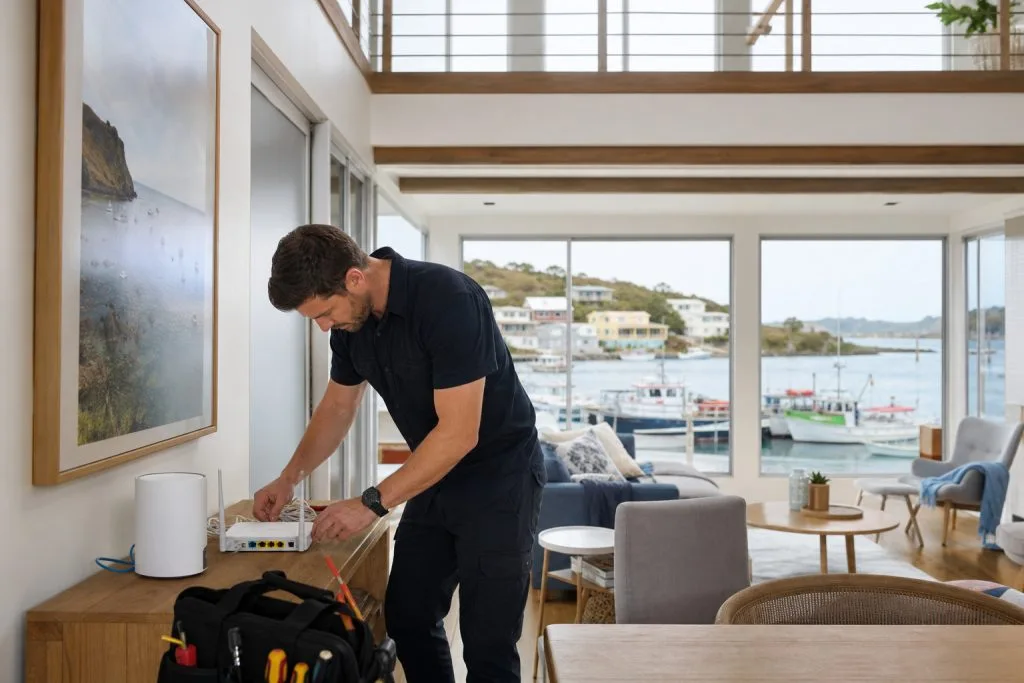
A single router sitting next to the TV is the most common WiFi setup we see around St Helena Bay, and it is also the most common reason people complain about dead spots. Thick coastal walls, a double-storey layout and that all-important stoep all conspire to leave you with no signal exactly where you most want to relax.
It is a particular headache in holiday homes and guesthouses, where guests expect WiFi everywhere and patchy internet is one of the fastest routes to a bad review. The good news is that whole-home coverage is very achievable: it just takes the right approach rather than simply buying a "more powerful" router and hoping.
Why one router is never enough here
WiFi is a radio signal, and radio signals do not love obstacles. Every wall, floor and large appliance between your router and your phone weakens the signal. Coastal homes tend to be solidly built: exactly the kind of thick brick and concrete that WiFi struggles to punch through. Add a staircase and a separate entertainment area outside, and a single router in the lounge simply cannot reach.
Cranking up one router rarely helps. Past a certain point you are just shouting louder from the same spot: the bedrooms upstairs and the patio out back still cannot hear it clearly.
Step one: find the dead zones
Before fixing anything, it pays to understand where the signal actually drops. A quick WiFi survey walks the property and maps the weak spots room by room. From there it becomes a question of getting strong signal to those specific areas reliably, rather than guessing. This is the first thing we do on any WiFi and network callout.
Step two: mesh or access points
For most homes the answer is a mesh system or a couple of well-placed access points. Both spread coverage by adding extra broadcast points around the house, so you stay connected as you move from room to room.
- Mesh systems use several units that talk to each other and hand your device off seamlessly as you move, simple and tidy for a typical home.
- Wired access points are even more reliable, because each one connects back to the router with a network cable rather than relying on a wireless hop.
- Structured cabling to an upstairs point and one near the patio means the whole property, and the garden: finally gets covered.
Running a proper cable to where the signal is needed is the single biggest upgrade for a double-storey place. Wireless-only mesh works, but every wireless hop loses a little speed; a cabled backbone keeps the upstairs and outdoor points running at full strength.
Holiday homes and guesthouses need more
If you let your place out, reliable WiFi is no longer a nice-to-have: it is part of the offer. Guests stream, work and video-call, often several at once, and they notice immediately when it drops. We design coverage around how the space is actually used: strong signal in every bedroom, the lounge and the outdoor areas, with enough capacity for a full house of devices.
It is also worth getting the WiFi sorted at the same time as the TV side of things. If you are setting up or reconnecting a holiday house, our guide to getting a holiday home TV-ready covers doing it all in one visit, and many owners add CCTV with remote viewing so they can check on the place, and its internet-connected cameras, while it stands empty off-season.
Fibre, LTE or fixed wireless?
Coverage inside the house is only half the story: the connection coming in matters just as much. Around St Helena Bay and the West Coast, what is available varies street by street: some areas have fibre, others rely on LTE or fixed-wireless routers, and the right choice depends on your address and how heavily you use it. Whatever line you are on, the in-home coverage still has to be sorted separately: a fast fibre line is wasted if the signal cannot reach the bedrooms. We set up routers, fibre ONTs and LTE units, and then build the mesh or cabling around them so the speed you are paying for actually reaches every room. If you are not sure what your place can get, we can talk you through the realistic options for your particular spot.
The bottom line
Getting the WiFi right is often just one part of a bigger visit: our DStv installers in St Helena Bay can sort your signal, decoder and network in the same callout.
n
If your WiFi drops in the back bedroom or dies the moment you step onto the stoep, you do not need a more expensive router: you need coverage designed for your actual home. A survey, the right mix of mesh or access points, and a bit of proper cabling will get every corner connected and keep it that way. We do this work across St Helena Bay and the wider West Coast. Send us a message and we will get you covered, top to bottom and out to the patio.
Keep reading
Fibre or LTE WiFi Router: Which Suits Your Home?
Fibre or LTE for your home WiFi? A side-by-side look at speed, data, setup and streaming, with advice…
GuidesDStv Explora Ultra Mistakes New Owners Make
Seven common DStv Explora Ultra mistakes, from the wrong LNB to forgotten fees, and how to avoid them…
GuidesHow to Activate DStv Decoder in St Helena Bay: 6 Easy Steps
New or second-hand decoder? Here is how to activate a DStv decoder in St Helena Bay in 6…