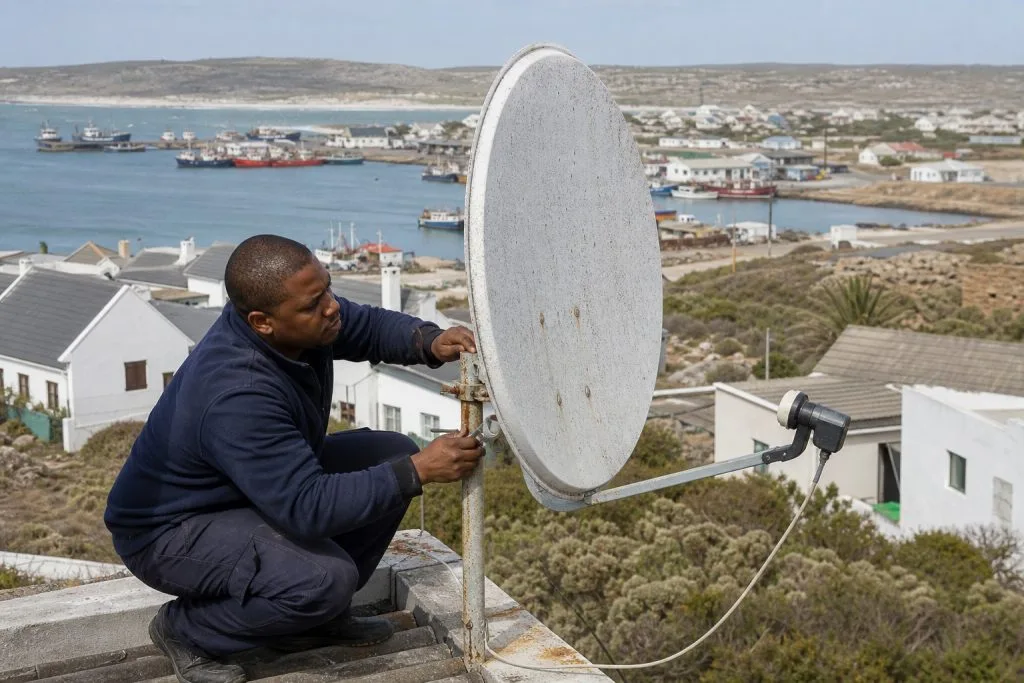
Anyone who lives around St Helena Bay knows the salt gets into everything. Door hinges seize, braai grids rust, car panels bubble, and your satellite equipment is no exception. The constant salt-laden air that blows in off the bay speeds up corrosion dramatically compared with an inland install, and it is the single biggest reason coastal dishes start losing signal after a few short years.
It is not the dramatic failures that catch people out. A dish rarely dies overnight. Instead the salt works quietly: it dulls the metal, creeps into every join, and slowly eats away at the parts that carry your signal. By the time the picture starts dropping out, the damage has usually been building for a season or two.
Where the salt does its damage
There are three usual culprits on a coastal dish. The first is the LNB: the arm at the front of the dish that actually collects the signal. The second is the F-connectors, the small screw fittings where the cable joins the dish and the decoder. The third is the cable itself, especially where the outer sheath has cracked in the sun and let moisture creep in.
Once salt and moisture reach the copper inside, signal quality starts to slide. First you notice pixelating when the weather turns. Then "searching for signal" appears more and more often, until one windy evening it simply will not come back. If that pattern sounds familiar, it is almost always corrosion rather than a broadcast or subscription problem.
Why a cheap inland-style install never lasts here
Plenty of dishes around the bay were fitted with standard hardware that would be perfectly fine in Paarl or Worcester. On the coast that same hardware is on borrowed time. The bolts rust, the bracket weakens, and the un-sealed connectors invite the salt straight in. That is exactly why our new DStv installations use corrosion-resistant fittings and weatherproofing from day one: it costs a little more up front and saves a reinstall down the line.
How a proper coastal install is different
- Corrosion-resistant LNBs rather than the cheapest available unit.
- Every connector weatherproofed with the right boots, self-amalgamating tape and sealant.
- UV-stable cable rated for outdoor coastal use, not the bargain coax that perishes in two summers.
- Marine-grade brackets and bolts that hold their strength in salt air.
- A mount sited, where possible, out of the worst of the wind and spray.
This is also why precise dish alignment matters so much here. A dish that is already fighting corrosion has no margin to spare: if it is also a degree or two off true, the smallest knock or storm tips it into no-signal. Get the alignment exact and seal it against the salt, and the whole system has far more resilience.
Catching it early saves money
The good news is that salt damage is gradual, which means it is usually catchable. If your picture has only just started dropping out, a service visit to replace perished fittings and re-weatherproof the joins is far cheaper than a full reinstall, and it gets you back to a rock-solid signal. We cover this kind of work as part of our signal repair callouts, and most coastal corrosion jobs are a same-week sort-out.
It is worth remembering that salt and wind travel together. The same blow that drives salt into your fittings also nudges the dish, which is why the picture often fails first during a storm: there is more on this in our guide to losing signal in bad weather. If your home sits empty for stretches of the off-season, it is also worth reading our notes on getting a holiday home TV-ready before the family arrives.
How often should a coastal dish be serviced?
Inland, a satellite dish can run for many years untouched. On the St Helena Bay coast it pays to think more like you would about anything else exposed to the sea: a check every couple of years, rather than waiting for it to fail. A quick service visit looks over the LNB, the connectors and the cable, re-seals anything the salt has started to open up, and confirms the alignment is still on peak. It is a small, inexpensive job that heads off the bigger one. We will happily tell you honestly whether yours is fine for another season or due for attention: there is no value to us in selling work that is not needed, and on a coast this size our reputation travels by word of mouth.
The bottom line
Salt-air corrosion is one of the main reasons homeowners along this coastline choose an accredited DStv installation St Helena Bay team that understands coastal installs from the outset.
n
Living by the sea will always be harder on equipment than living inland: there is no avoiding that. But a dish installed and sealed for the coast, with the right materials and proper alignment, will give you years of reliable viewing instead of an annual battle with the salt. We work right across St Helena Bay, Shelley Point, Britannia Bay and the wider West Coast, and we are happy to take a look and tell you honestly whether yours needs a quick service or a proper coastal upgrade. Get in touch and we will sort it.
Keep reading
DStv Stream vs Decoder in St Helena Bay: 6 Myths and Facts
DStv Stream or a decoder? We clear up six common myths, compare October 2026 prices and explain what…
GuidesDStv Decoder Price St Helena Bay: 2026 PEP, Game & Makro Guide
What does a DStv decoder cost in St Helena Bay right now? October 2026 prices for HD, Explora…
HomeOpenView Decoder Kit Price 2026: Retail vs Installer
Shop box, retail bundle or local installer? How the OpenView decoder kit price compares, and which route suits…