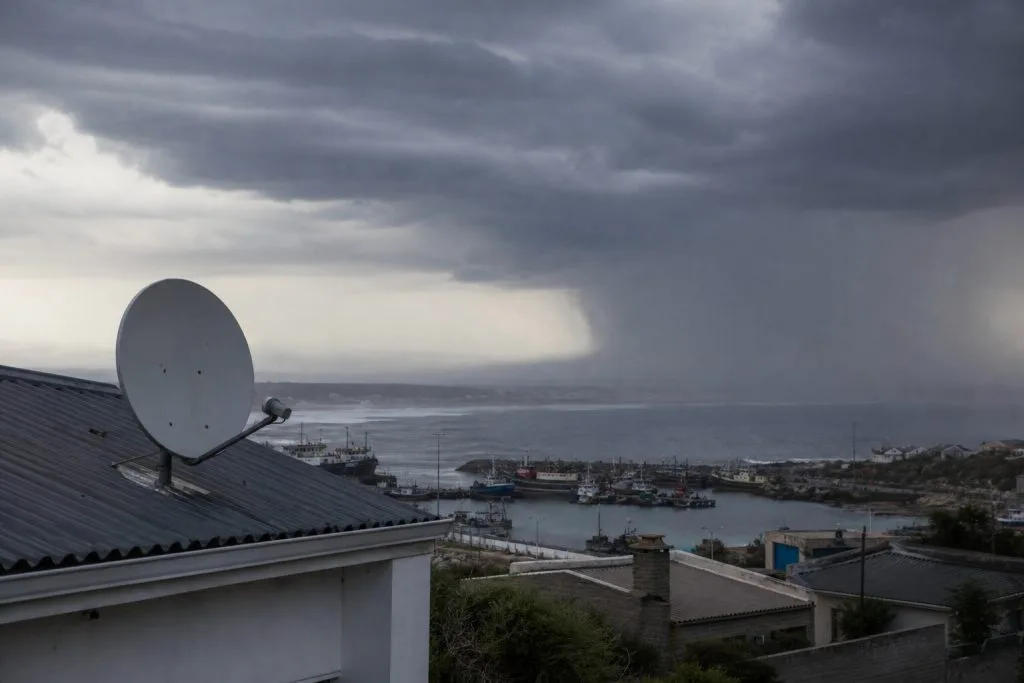
A storm rolls in off the bay, the wind picks up, and right on cue the picture freezes and "searching for signal" appears. Before you panic or start blaming DStv, it helps to understand what is actually going on, because some of it is completely normal, and some of it is a sign that your dish needs attention.
Some signal loss in heavy rain is normal
It is called rain-fade, and even a perfect installation can flicker in a proper West Coast downpour. Your signal travels a very long way down from a satellite roughly 36,000 km up, and a thick wall of rain in between can briefly weaken it. Usually it clears the moment the worst of the weather passes. A short drop-out during the heaviest part of a storm, that comes right again afterwards, is nothing to worry about.
When it is more than rain-fade
The problem is when the picture fails too easily: in light rain or just a stiff wind, or stays out long after the weather has cleared. That is the tell-tale sign of an underlying fault, and on this coast it is nearly always one of three things:
- A dish that has drifted out of alignment. The wind off the bay slowly nudges a dish off true, until it has no margin left when the weather turns.
- An ageing or corroded LNB. Salt air eats the unit at the front of the dish, and a tired LNB struggles the moment conditions get marginal.
- Water in a connector. A poorly-sealed join lets moisture in, and the first wet, windy spell brings the fault on.
All three are coastal classics, and all three are closely tied to the salt-air corrosion we cover in our guide to how salt air affects your dish. The wind that knocks the dish and the salt that corrodes the fittings are the same weather doing two jobs at once.
Safe checks you can do yourself
There are a few things worth trying before you call anyone out: none of which involve climbing onto a roof in the wind:
- Check that nothing has blown against the dish or in front of it.
- Make sure the cable is firmly screwed into the back of the decoder: they do work loose.
- Give the decoder a full restart at the plug and let it re-scan.
- Wait until the rain stops, and see whether the picture comes back clear on its own.
If the picture returns the moment the weather clears, you most likely just had rain-fade and there is nothing to fix. If it keeps dropping out, or fails in only light rain, that is worth a proper look.
What we would steer you away from
Please do not climb up to "nudge" the dish back yourself in a blow. It is the fastest way to turn a small alignment drift into a much bigger problem, and a roof in coastal wind is no place to be balancing with a spanner. Even if you get the picture back for a day, a dish pushed roughly by hand is not actually aligned, and the next storm puts you straight back to square one.
Why the wind matters as much as the rain
On most of the country, weather signal loss is all about rain. On this stretch of coast the wind is just as much to blame. The south-easter and the winter gusts off the bay do two things at once: they physically push at a dish that is not solidly mounted, and they drive salt deep into every join. A dish can be perfectly aligned in calm weather and still fail in a blow, simply because the wind is moving it a fraction past the point where it holds signal. That is why we treat alignment and mounting as one job here: re-aiming the dish is pointless if the bracket lets it drift again with the next strong wind. A mount rated for coastal wind load, anchored solidly and sited out of the worst gusts where possible, is what turns a temperamental setup into one that simply keeps working.
How we fix it properly
When we come out for a signal repair, we meter the signal to find exactly where it is being lost, identify the real cause: alignment, LNB, connector or cable, and fix that root cause rather than guessing. Then we re-seal every join so the same fault does not creep back with the next wet spell. If the dish itself has drifted, a proper re-alignment with a meter brings it back to peak and mounts it to hold against the wind.
Weather-related faults are exactly the kind of thing an experienced accredited St Helena Bay DStv installer sorts quickly, with the root cause fixed properly rather than a temporary patch.
n
Most weather-related faults are a single same-day or next-day visit, and we give clear pricing up front once we have metered the system. We cover St Helena Bay, Shelley Point, Britannia Bay and right across the West Coast. If your picture keeps surrendering to the weather, give us a shout: it is usually a quick, affordable fix that ends the storm-night drop-outs for good.
Keep reading
Solar CCTV Camera Buying Checklist: What to Check
A simple checklist for buying a solar camera that survives wind, salt air and long distances: sun, signal,…
TroubleshootingDStv Remote Not Working? 7 Fixes for St Helena Bay Homes
DStv remote not working? Most remotes in St Helena Bay are not broken. Learn what the light colours…
GuidesWhere We Work: DStv Installation Across St Helena Bay and The West Coast
.wa{color:#243447}.wa h2{font-size:clamp(24px,3vw,32px);font-weight:800;line-height:1.2;margin:38px 0 14px;color:#0F2741}.wa h3{font-size:clamp(18px,2.2vw,22px);font-weight:700;mar